
Site Speed Audit
Is your site speed costing you sales?
For every 100 milliseconds slower a store loads, conversion tends to be about 3.5% lower.1 Measure your storefront’s performance to see how it compares to industry benchmarks and your competition.
What’s included in your report:

Personalized site speed analysis
See how your storefront stacks up against industry benchmarks and your competition.
By-platform speed comparisons
Compare your current platform to others in the industry.
Conversion insights from Shopify data
See how site speed relates to conversion, based on Shopify store data.
Why speed matters
What Shopify data shows about speed and conversion
Turn more shoppers into buyers
Slower stores convert fewer shoppers, according to Shopify store data. For every 32 milliseconds slower a store responds to interactions, conversion tends to drop by about 1.5%.1 Mature, high-volume stores see a smaller percentage impact, roughly a third of what smaller stores experience.1
Lower ad spend with better SEO
Google says its ranking systems use Core Web Vitals, which measure loading speed, interactivity, and visual stability.2 Web performance reports in the Shopify admin show how a store performs on them, based on real user data from the past 30 days.
Improve cost efficiency
Every Shopify plan includes hosting, unlimited bandwidth, and an SSL certificate. Nearly 80% of Shopify stores pass all Core Web Vitals thresholds, according to Chrome User Experience data.3
Shopify stores render 1.8x faster on average than stores on other platforms4
Shopify has the fastest server speed in commerce, up to 3.9x faster and on average 2.8x faster.4 93% of brands on Shopify have a fast storefront, more than any other major commerce platform.4

Shopify site speed compared with other ecommerce platforms
The table compares Shopify stores with stores on four other ecommerce platforms on render speed, the share of stores rated fast, and server speed.
| Shopify compared with | Render speed (FCP), on average | Stores rated fast | Server speed (TTFB) |
|---|---|---|---|
| BigCommerce | Shopify stores 1.4x faster4 | 93% of Shopify stores vs. 80%4 | Shopify 1.9x faster4 |
| Salesforce Commerce Cloud | Shopify stores 1.5x faster4 | 93% of Shopify stores vs. 65%4 | Shopify 2.2x faster4 |
| Adobe Commerce (Magento) | Shopify stores 2x faster4 | 93% of Shopify stores vs. 53%4 | Shopify 3.4x faster4 |
| WooCommerce | Shopify stores 2.4x faster4 | 93% of Shopify stores vs. 34%4 | Shopify 3.9x faster4 |
Sources: footnote 4. “Faster” means First Contentful Paint render speed; server speed means Time to First Byte. Neither is load time.
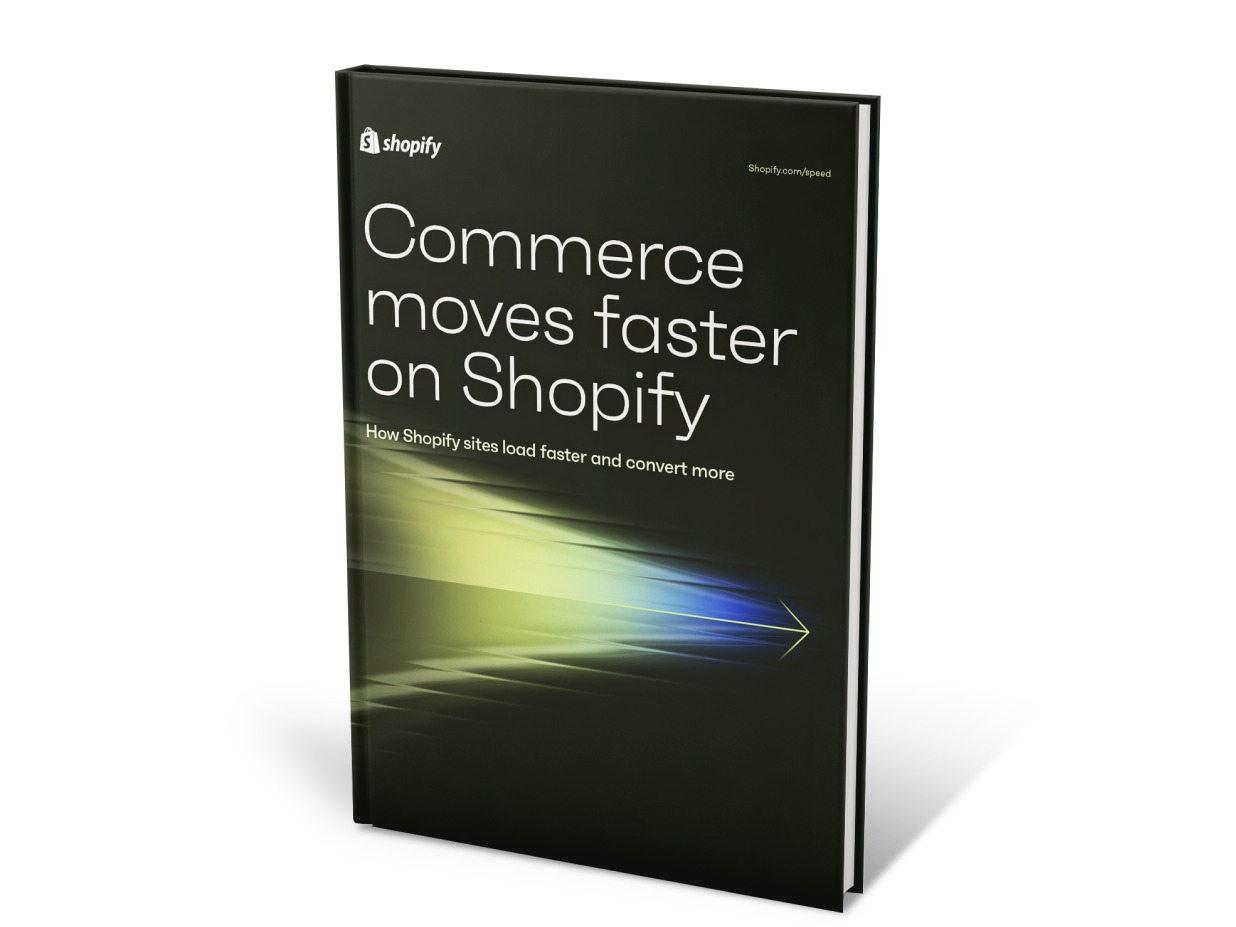
Whitepaper
Site speed best practices to boost conversion
Download the whitepaper for the research behind Shopify’s site speed figures and best practices from Shopify’s performance experts.
FAQ
Dive deeper with a Shopify expert
Schedule a personalized site speed evaluation to see how your business stacks up against Shopify stores similar to you.
- 1Shopify Enterprise blog, “Store Speed and Conversion: What the Data Shows,” April 27, 2026. Analysis of actively selling Shopify stores over a 28-day window in January and February 2026, excluding the slowest 5% of stores, with each Core Web Vitals metric controlled for the other two. These figures show correlation, not causation.
- 2Google Search Central, “Understanding page experience in Google Search results,” accessed October 9, 2026. Google states that Core Web Vitals are used by its ranking systems.
- 3Chrome User Experience Report data, as reported in Shopify Enterprise blog, “Store Speed and Conversion: What the Data Shows,” April 27, 2026. Core Web Vitals are Largest Contentful Paint, Interaction to Next Paint, and Cumulative Layout Shift.
- 4Shopify Enterprise blog, “Fastest Ecommerce Platform: Speed Benchmarks Compared,” August 29, 2024. Based on public Google Core Web Vitals data (real-user measurements) for a random sample of more than 200,000 homepages across revenue bands, verticals, and platforms. Render speed is measured as First Contentful Paint (FCP) and server speed as Time to First Byte (TTFB). A “fast” storefront is one rated fast on these measures.